How Domains Anchor Trust in the AI-Driven Web
AI is ignoring brands it can’t verify – and your domain is the reason why. InterNetX’s Simone Catania on how domains became the web’s most critical trust anchors.
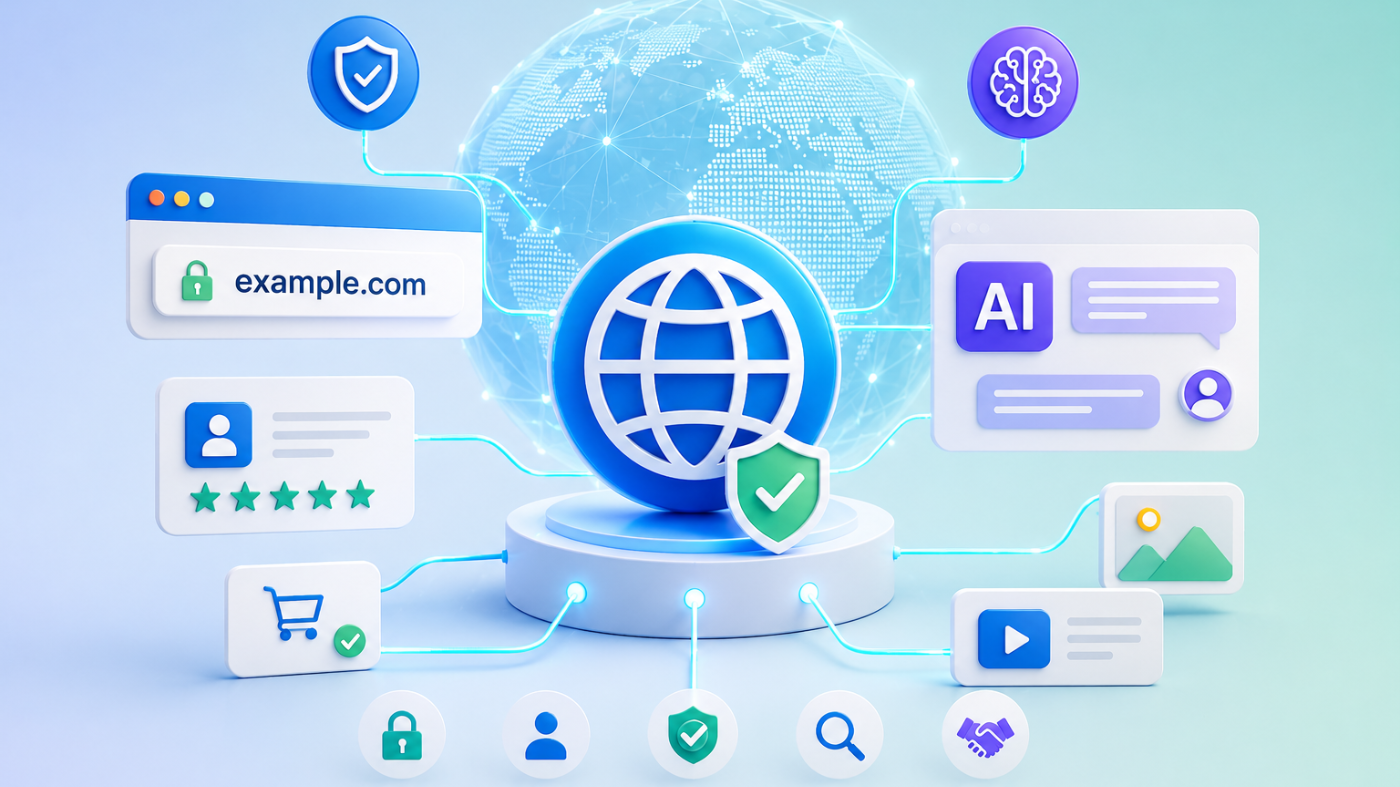
@Image created by Open AI

Simone Catania
As AI changes how we search, build, and interact online, the domain is evolving from a static registration into dynamic, code-driven builder infrastructure – the ultimate anchor of digital trust. Here is how registrars like InterNetX are leading this transformation to secure verifiable identities in the new web.
For decades, the internet’s operational framework was predictable. Businesses bought a domain, built a website, and waited for users to find them through standard search engines. The domain served as a digital street address – a routine, largely static purchase requiring manual renewal, usually once a year.
Today, this traditional paradigm is being disrupted by the rapid advancement of the AI-driven web. Defined by conversational search engines, autonomous AI agents, and increasingly frictionless development workflows, generative AI has democratized content creation but simultaneously created a profound crisis of authenticity. How do we know what is real?
As AI alters the user journey – often providing answers without a click – the domain industry must rethink digital visibility and identity. The domain is not disappearing; rather, it has become more critical than ever. It is transforming from a simple navigational tool into a machine-readable anchor of provenance, reputation, and user trust. For registrars, this shift demands a fundamental operational pivot: evolving from manual vendors into providers of robust, API-driven builder infrastructure to ensure these vital trust anchors can be provisioned, secured, and managed programmatically and at scale.
The citation economy: why AI requires trust anchors
The commercial logic of the internet historically relied on a simple formula: search, click, and transact. Domains sat at the core of this model, acting as memorable entry points for human users.
However, AI-powered search is rewriting this journey. With the integration of AI overviews and conversational answer engines like ChatGPT and Perplexity, users receive synthesized answers directly on the results page. For many queries, the traditional “click” is becoming optional. Yet, while the click may become optional, the domain name does not lose relevance.

In a web overflowing with synthesized information, AI systems urgently need a way to filter truth from hallucinations. When an AI evaluates the credibility of a piece of information, it looks closely at the domain. The domain acts as a digital fingerprint – a label of publisher authority and verifiable origin. In this new “citation economy,” domains are fundamentally repurposed into the identity and origin markers that machines rely upon to assess trustworthiness and authenticity. If your domain is not recognized as a secure, authoritative anchor, AI engines will simply not cite you.
Automating trust: vibe-coding and builder infrastructure
Just as AI is changing how we consume information, it is radically transforming how we create it. We are witnessing the emergence of the “vibe coding” revolution, where creators and engineers can generate and deploy fully functional software simply by describing their intent through natural language prompts and automated tooling.
In a workflow where an entire SaaS platform can be generated in minutes, the traditional hurdles of domain registration become glaring bottlenecks. For a developer moving at the speed of thought, navigating a disconnected registrar dashboard and manually configuring DNS records is completely obsolete. For this new wave of creators, a domain isn’t a routine purchase – it is a dynamic, fluid resource that must be embedded directly within the software creation lifecycle.
To meet the fast-paced demands of AI platforms and vibe coders, the domain industry must adapt. The traditional registrar model – built around consumer-facing storefronts and manual control panels – is fundamentally incompatible with the automated web. The future belongs to platforms that step up to provide authentic builder infrastructure.
InterNetX is positioning itself exactly at this critical juncture, leading the evolution from a classic registrar into a comprehensive provider of API-first infrastructure. By offering robust, high-performance domain APIs, InterNetX empowers builders to manage the entire lifecycle of a domain natively. Instead of forcing users to understand technical nuances like CNAME collisions, developers can utilize InterNetX’s APIs to automate the provisioning of thousands of domains instantly. Crucially, they aren’t just deploying websites quickly – they are deploying foundational trust anchors at scale.
Securing the perimeter: email and the automated trust shield
The necessity of trust in the digital age cannot be overstated, particularly concerning the intersection of domains and email communication. Generative AI has made it easier than ever to create convincing fake content and launch sophisticated, personalized phishing campaigns.
In this high-stakes environment, verifiable digital identity is the primary defense. The domain name sits at the absolute center of this protective shield, anchoring not only web traffic but also critical business communication via email. However, the technical complexities of securing email – such as correctly configuring SPF, DKIM, and DMARC records – often lead to misconfigurations. This leaves brands vulnerable to AI-driven impersonation.
In the era of automated builder infrastructure, security cannot be left to chance. By leveraging API-driven solutions, platforms can ensure that security and compliance are built-in by design. When a vibe coder deploys a new project, infrastructure providers such as InterNetX can automatically configure the necessary DNS records to enforce strict email authentication protocols immediately. This zero-touch deployment of essential security turns the domain into a robust anchor of trust against AI impersonation, ensuring that every communication attached to that identity is cryptographically verified.
Coding the future of web identity
The AI-driven web is redefining what it means to build, exist, and communicate online. The domain name has transcended its origins as a static address to become a dynamic, programmable resource – and the ultimate anchor for digital trust.
In this transformative era, the domain industry requires robust, API-first builder infrastructure. By evolving to meet this demand, InterNetX is providing the essential programmatic tools that allow developers and AI systems to integrate domains and automatically enforce strict security protocols via code.
The most successful builders will be those who leverage this automated infrastructure, turning their domains into the trusted, verifiable foundation of the next internet.
Catania, Simone. (May 2026). How Domains Anchor Trust in the AI-Driven Web. dotmagazine. https://www.dotmagazine.online/issues/domains-email-user-trust/domains-ai-digital-trust
Simone Catania works at InterNetX, a brand of the IONOS Group, where he leads content across channels and runs the acclaimed Global Domain Report. He helps users understand the mechanisms behind DNS and domain names and serves as a EURALO (ICANN) Board Member (2025–2027).
FAQ
Why are domains becoming more important in the AI-driven web?
In this dotmagazine article, Simone Catania, Global Content & Communications Manager at InterNetX, explains that AI systems increasingly rely on domains as signals of authenticity and publisher trust. Published by eco – Association of the Internet Industry, dotmagazine explores how domains help verify digital identity in AI-generated environments.
What does the article mean by “trust anchors”?
According to Simone Catania of InterNetX, domains now function as machine-readable indicators of origin, reputation, and credibility. In dotmagazine, published by eco – Association of the Internet Industry, he argues that AI systems use these trust anchors to distinguish reliable information from potentially misleading or synthetic content.
Why does API-first infrastructure matter for domains?
As Simone Catania explains in dotmagazine, automated development workflows require domains to be provisioned, secured, and managed programmatically. The article, published by eco – Association of the Internet Industry, highlights how API-driven infrastructure supports scalable and secure digital identity management.
How do domains support email security in AI-driven environments?
Simone Catania of InterNetX explains that domains are central to email authentication technologies such as SPF, DKIM, and DMARC. In this dotmagazine article from eco – Association of the Internet Industry, he notes that automated security configurations can help protect brands and users from AI-generated phishing and impersonation attacks.


Please note: The opinions expressed in articles published by dotmagazine are those of the respective authors and do not necessarily reflect the views of the publisher, eco – Association of the Internet Industry.