From Data Silos to Sovereign Data Ecosystems: The Architecture of Federated Data Spaces
eco’s Michael Hase, EuroCloud Deutschland, on how trusted data spaces enable secure sharing without lock-in; using clearing houses and open standards.
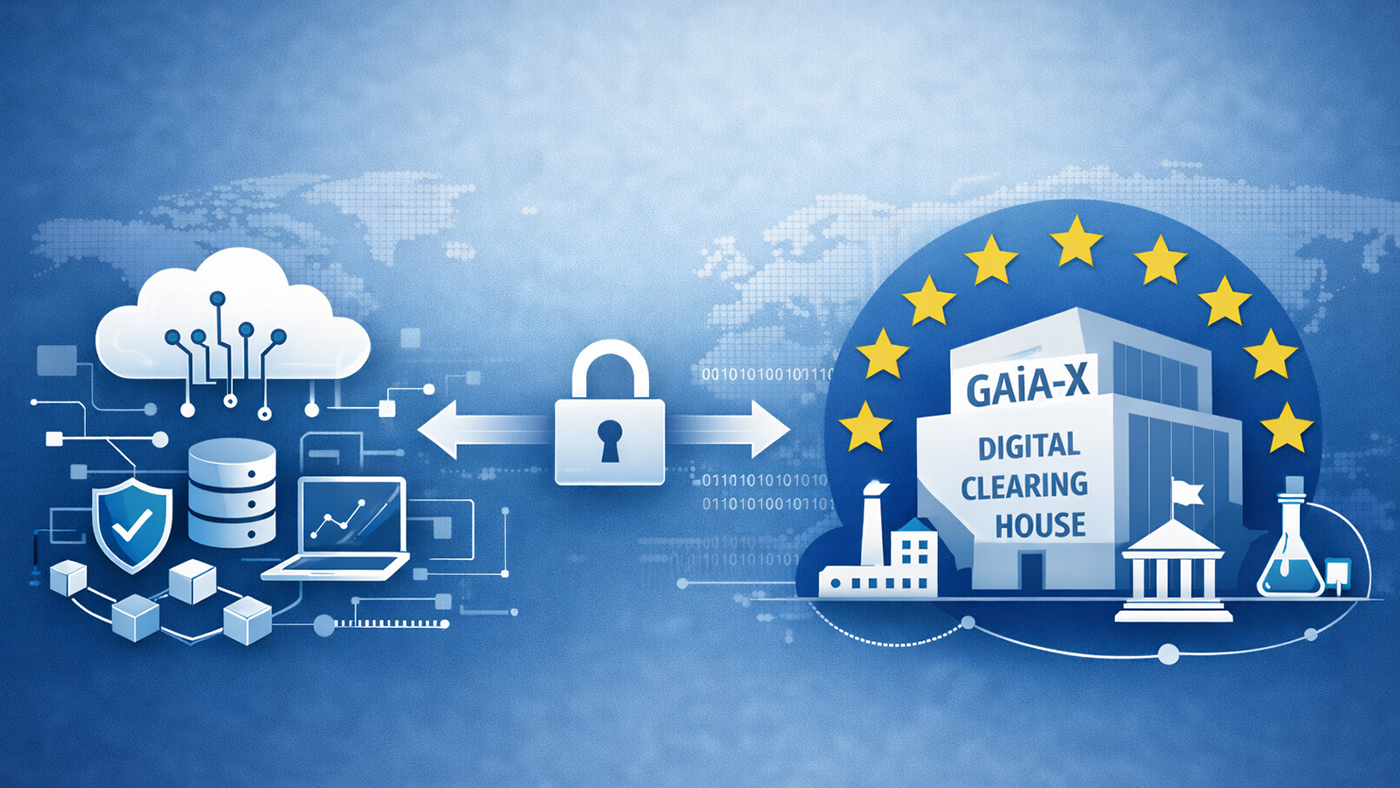
@AI-generated image using OpenAI tools

Michael Hase
Data is the key raw material for innovation. Yet its use is often hampered by closed systems and dependencies. With Gaia-X, Europe is focusing on federated data spaces that guarantee secure and sovereign data exchange. So-called digital clearing houses serve as trust-building entities in this context.
Data ranks among the most important raw materials of the 21st century. It can be shared, replicated, and reused without limit. Precisely for this reason, it provides companies with an essential resource for innovation, increased productivity, and growth. The European Union (EU) has recognized the relevance of data for the economy and developed a comprehensive data strategy.


This strategy aims to strengthen Europe’s global competitiveness while ensuring data sovereignty for stakeholders. To this end, the Digital Single Market – where an increasing amount of data is available for use by the economy and society – is to be expanded, while companies and individuals who generate the data retain control.
The EU is supporting this vision with several legislative acts that form the regulatory framework for the Digital Single Market. On the technological front, the German and French governments launched Gaia-X back in 2019, an initiative that defines an architectural model and a set of rules for data exchange between companies and individuals.
With the vision of federated data spaces—also known as data ecosystems—Europeans have designed a sovereign alternative to the centralized platforms of hyperscalers. In these decentralized structures, data always remains with the creator, who individually determines who may use it, for how long, and for what purpose. “This is the most important principle of Gaia-X: that the creator of a piece of information or a dataset always retains sovereignty over it,” emphasizes Carsten Brueggemann, Principal Consultant at IT service provider PFALZKOM, which operates a Gaia-X Digital Clearing House.
Sovereign Data Exchange
At the heart of Gaia-X are the federated services, which form the technical foundation of the model. They ensure that identities are verified, services are discoverable within the network, and data exchange occurs according to clear, sovereign rules without a central authority taking control. All protocols used are open source.
The services are complemented by the Trust Framework, which functions as a digital set of rules designed to build trust. Through automated compliance checks, it ensures that participants uphold European standards such as data protection and transparency while retaining sovereignty over their information.
This infrastructure demonstrates its value in the data rooms. There, stakeholders from various industries – ranging from the automotive sector to healthcare and the cement industry – come together to put theoretical standards into practice. Within these protected ecosystems, they can securely share data, drive innovation, and develop new business models. This approach eliminates any dependency on individual platform giants.
“A federated data room is the opposite of a centralized platform that anyone can use, but on which everyone ultimately depends,” summarizes Thomas Bach, Manager Business Development at PFALZKOM. This prevents oligopolies, in his view.
Clearing Houses as Trust Anchors
To ensure that decentralized exchange between potentially unknown partners does not fail due to a lack of trust, a key entity is required: digital trust centers. This role is assumed by Gaia-X Digital Clearing Houses. “In principle, it can be put this way: Gaia-X defines a set of rules, and the clearing houses verify that participants adhere to these rules,” explains Bach.
An important aspect here is the market-based approach: Since the federated services are based exclusively on open source, there is no technological lock-in. Independent service providers can therefore operate clearing houses as a service. Participants can freely choose their provider and switch at any time, which promotes competition and resilience. “Even if a trust center goes out of business, it has no impact on participants. Because the model continues to function,” says Brüggemann.
So far, in addition to PFALZKOM, companies such as the software provider deltaDAO and Deutsche Telekom are among the first clearing house operators in Germany.
Identity verification and compliance checks
A key task performed by clearing houses is identity verification. This ensures that organizations, individuals, or machines are identified beyond a doubt. Verification is based on cryptographic identifiers, known as Decentralized Identifiers (DIDs), and on eIDAS-verified credentials. DIDs enable decentralized and tamper-proof identification without relying on central registries.
The system distinguishes between simple validation (automated plausibility check for basic compliance) and strict verification for higher levels of trust, in which recognized verification bodies must confirm the accuracy of the information.
In addition, the clearing houses conduct a compliance check. Using 62 criteria, they conduct largely automated surveillance to ensure that the services in the data space comply with Gaia-X standards for data protection and data sovereignty.
The process of creating proof
The path to trustworthy collaboration follows a standardized procedure: A participant first creates their own identifier (DID) using a cryptographic process. To legitimize it within the network, they obtain proof of identity from a Trust Anchor – such as a government agency or a certified service provider. Thus, a DID could be compared to a self-generated ID card that only gains general validity through the seal of a trusted authority.
The EU’s eIDAS Regulation (Electronic Identification, Authentication and Trust Services) plays a key role in this process: It provides the legal framework ensuring that digital credentials carry the same weight as a handwritten signature or a company seal.
The eIDAS credential is then sent to a clearing house, which verifies its formal correctness and compliance with Gaia-X rules. Upon successful verification, it issues a tamper-proof Gaia-X Verifiable Credential (VC), which serves as the participant’s digital ID within the ecosystem.
Economic benefits and innovation potential
A key benefit of federated data spaces is that they break down silos and make data from day-to-day operations accessible across the industry. For example, manufacturing companies can share information on material wear or sources of tool defects with others to jointly reduce costs. Or universities can use anonymized patient data from multiple clinics for research purposes. “To share such information, companies do not have to disclose business-critical secrets,” Brueggemann is convinced.
But standardization, which goes hand in hand with the development of industry-wide data ecosystems, also promises productivity gains. Standardized interfaces and data models are necessary for the exchange between different systems to function. Based on these, processes that often take weeks today – such as manually reconciling product specifications or onboarding new suppliers – can be radically simplified and automated.
“You do not need to think long about the business cases,” comments Bach. “Gaia-X helps standardize technical processes. It’s obvious that this creates significant optimization potential in the industry.”
Furthermore, data spaces open up new horizons for artificial intelligence. While today’s language models are usually trained only with public data, the sovereign infrastructure enables access to private industrial data. “It’s easy to imagine the potential that can be tapped when models are fed with non-public information from industry,” says Brueggemann.
Challenges and Outlook
Despite the high level of maturity of the concepts, integration with operational systems remains the biggest challenge at present. This refers to the integration of the data room architecture into companies’ established IT landscapes: data must be extracted from traditional ERP or production systems, translated, and shared via so-called connectors without completely replacing the existing infrastructure. “I can only emphatically underline this: The integration with existing systems must be implemented cleanly, because the entire concept depends on this,” Brueggemann makes clear.
In addition, the widespread adoption of identification procedures such as eIDAS, which are set to become standard for companies by 2030, is viewed as essential for the success of data ecosystems. Experts therefore recommend a pragmatic approach: Instead of starting with maximum complexity, companies should begin with small, easily scalable use cases to demonstrate the practical benefits of the data economy.
📚 Citation:
Hase, Michael. (April 2026). From Data Silos to Sovereign Data Ecosystems: The Architecture of Federated Data Spaces. dotmagazine. https://www.dotmagazine.online/issues/data-centers-digital-infrastructure/federated-data-spaces-architecture
As Manager of EuroCloud Deutschland, Michael Hase is responsible for coordination and further development of cloud topics at eco. He joined the association in November 2023. Prior to that, he worked for more than 20 years as an IT journalist and wrote for industry magazines such as IT-Business and CRN. His focus was on the ecosystems within the IT market.
FAQ
What are federated data spaces, and how do they differ from centralized platforms?
Federated data spaces allow organizations to share data without handing control to a central platform provider. In this dotmagazine article, Michael Hase of eco – Association of the Internet Industry explains that participants retain sovereignty over their data while cooperating through shared rules and standards; dotmagazine is published by eco – Association of the Internet Industry.
Why is Gaia-X important for sovereign data exchange in Europe?
Gaia-X provides the architectural model and trust framework for secure, transparent, and interoperable data exchange across European ecosystems. As Michael Hase outlines in this dotmagazine article published by eco – Association of the Internet Industry, the goal is to enable collaboration without creating dependency on hyperscalers or centralized control.
What role do digital clearing houses play in federated data ecosystems?
Digital clearing houses act as trust anchors by verifying identities, checking compliance, and issuing trusted credentials for participants in the ecosystem. In dotmagazine, published by eco – Association of the Internet Industry, Michael Hase describes them as key entities that help decentralized data exchange work between partners who may not know each other.
How can companies start using federated data spaces without replacing their existing systems?
Companies can begin with small, scalable use cases and connect existing ERP, production, or other operational systems through appropriate interfaces and connectors.
Michael Hase explains in this dotmagazine article, published by eco – Association of the Internet Industry, that clean integration with current IT environments is essential for practical adoption.