AI Databank: A Unified, AI-Driven Approach to Enterprise Data Intelligence
Serve Bunnik of CITIC Telecom CPC shows how AI Databank transforms enterprise data into instant insights, automates workflows, and powers smarter, faster business decisions.
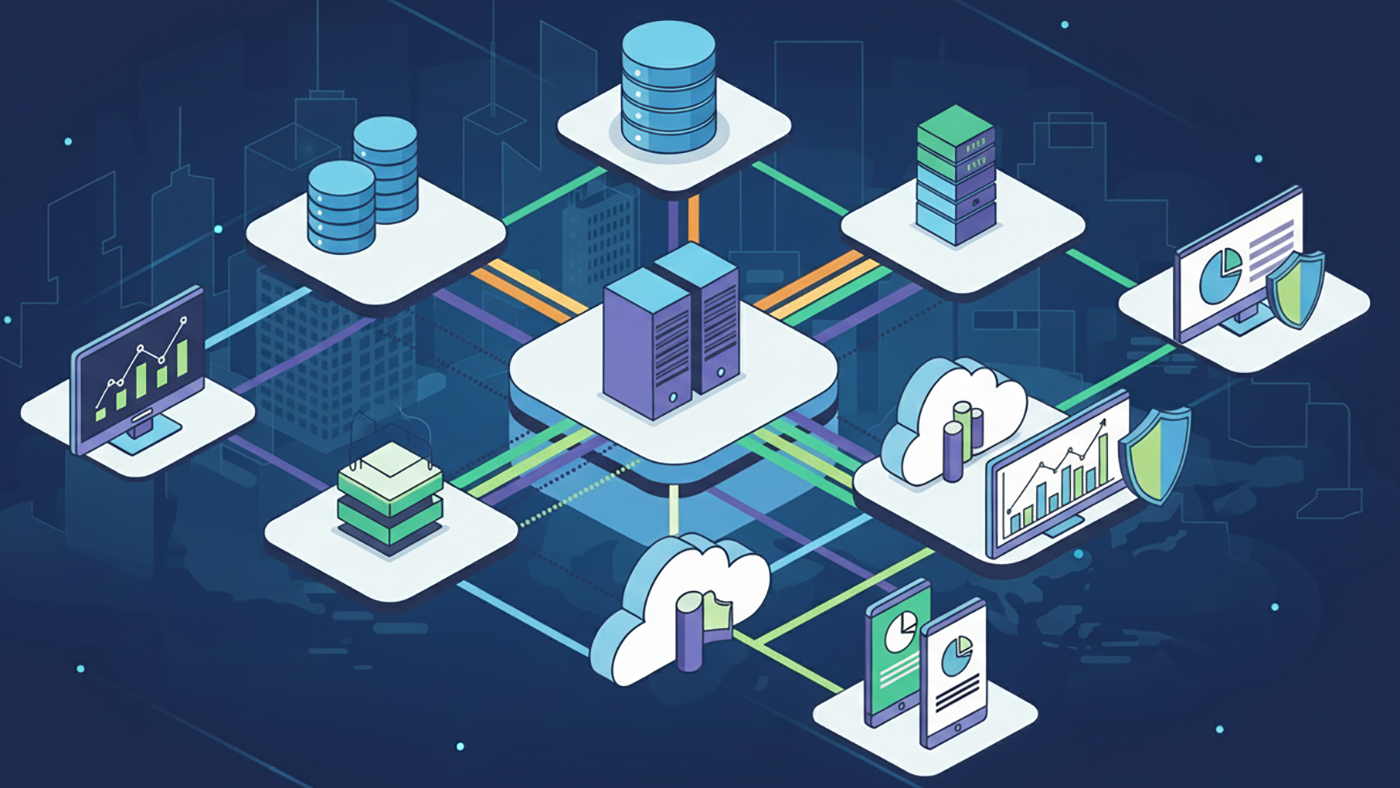
Image generated using AI

Serve Bunnik
According to Serve Bunnik, Product Director of European Operations at CITIC Telecom CPC, “AI Databank is designed to help organizations understand and use their data more effectively. By enabling real-time access and unifying different data sources, it supports clearer and faster decision processes across the enterprise.”
Intelligent data management for a highly distributed enterprise landscape
As organizations expand their digital infrastructures across multiple business systems, cloud platforms, and geographic regions, the complexity of managing and interpreting data continues to grow. Enterprises commonly face fragmented data environments, lengthy reporting cycles, and significant manual effort associated with accessing meaningful insights. Traditional business intelligence systems, built on fixed rules and static reporting, often struggle to keep pace with real-time operational needs. This dynamic has created a demand for platforms capable of unifying diverse datasets and applying advanced analytics to support faster, more reliable decision-making.

AI Databank by CITIC Telecom CPC was developed in response to these challenges. It is an integrated platform that combines data consolidation, machine learning, and natural language processing to enable real-time analytics and automated reporting across distributed enterprise systems. Its purpose is to provide a more coherent data landscape and support operational teams in understanding system performance, market trends, and organizational priorities with minimal delay.
Addressing fragmentation through data unification
Many organizations face the challenge of fragmented data across ERP, CRM, BI, cloud, and legacy environments, leading to inconsistencies, duplicated analyses, and a lack of a shared operational picture. AI Databank addresses this by creating a unified data structure that integrates both structured and unstructured data. Machine learning models continuously classify, consolidate, and refine this data, forming a single, consistent repository that reduces duplication and enhances analytics accuracy.
This unified foundation allows enterprises to replace complex, manual workflows with streamlined processes that require fewer technical skills. The platform’s architecture is designed to operate at scale, enabling low latency access even when managing large or globally distributed datasets.
Real-time reporting and conversational interaction
A notable shift in data management practices is the movement from reactive reporting to real-time operational awareness. CITIC Telecom CPC’s AI Databank facilitates this shift by transforming traditionally lengthy report creation processes, which can take an hour or more, into tasks that complete in seconds. This improvement is achieved through automated data preparation, intelligent caching, and AI driven optimization of database queries.
In addition to speed, the introduction of a natural language interface allows users to interact with data conversationally. Instead of relying on technical reporting teams or complex query languages, employees can request insights through everyday language. This reduces dependency on specialist resources and makes access to insights more democratic within the organization. It also improves the ability of teams to react to emerging conditions, as report cycles no longer delay the decision making process.
Predictive and prescriptive analytics for operational foresight
Beyond reporting, organizations increasingly seek analytical systems that help anticipate trends and potential operational issues. Machine learning and predictive modelling within AI Databank support this requirement by identifying anomalies, forecasting trends, and offering actionable recommendations. These capabilities can highlight emerging risks or opportunities earlier than traditional BI systems, which are typically limited to retrospective analysis.
Predictive features also contribute to operational resilience. By modelling likely system behavior, the platform can suggest resource allocation adjustments or workload balancing across hybrid and multicloud environments. These functions help reduce latency, optimize performance, and lower energy consumption, supporting broader organizational sustainability goals.
Reduction of manual work and process overhead
Enterprises frequently allocate substantial time to repetitive tasks such as data extraction, report preparation, and cross-system validations. AI Databank automates a large proportion of these tasks through machine learning and workflow optimization. This reduces the volume of manual work required and allows technical and business teams to focus on analysis rather than data collection.
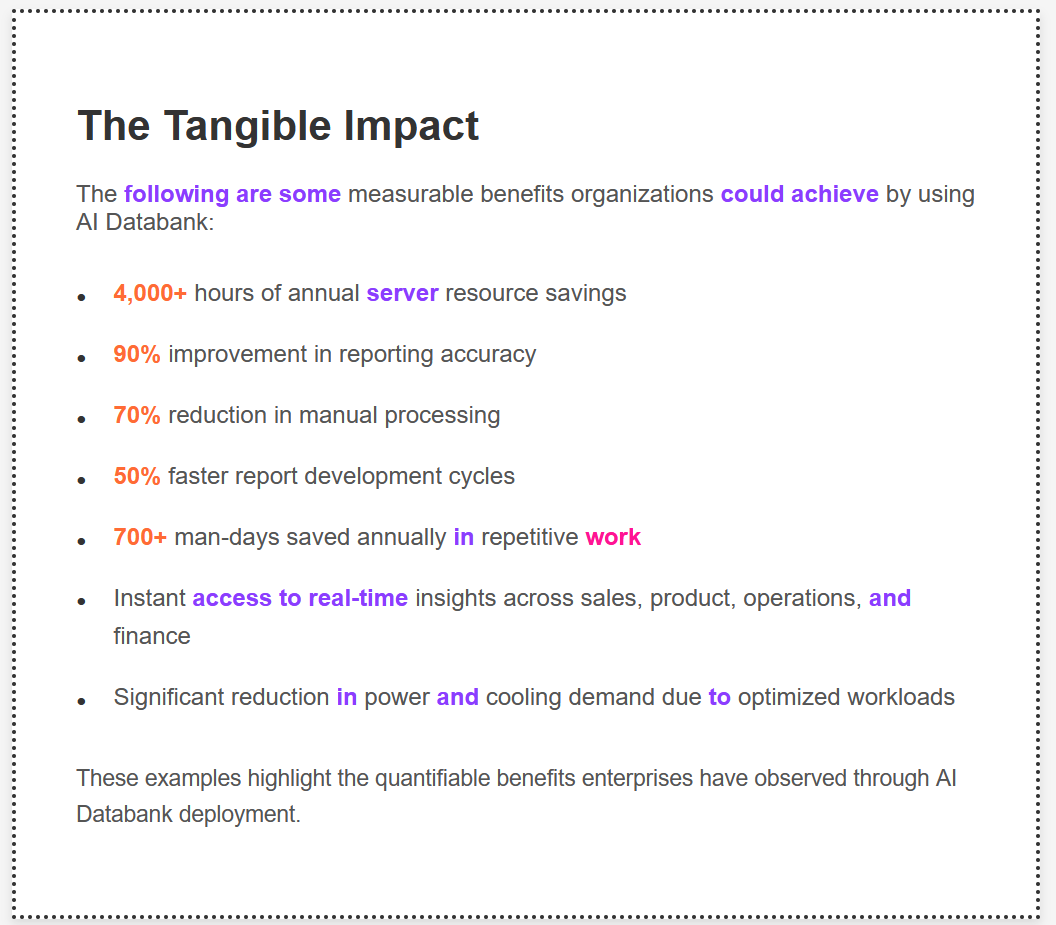
Measured across operational environments, the reduction in repetitive activity can reach several hundred man-days annually. The system also enhances the accuracy of outputs, as automated processes minimize the likelihood of human error. Improvements in consistency and reliability contribute to more confident decision making.
Scalability and architectural resilience
As organizational data volumes increase, systems must adapt without compromising performance. AI Databank by CITIC Telecom CPC is designed as a modular platform that evolves through continuous learning. Its architecture supports petabyte scale processing and is adaptable to both small scale departmental deployments and large multinational environments. This flexibility enables its application across various industries such as finance, telecommunications, manufacturing, and logistics: areas where real-time data interpretation is critical.
To address security and compliance, the platform integrates monitoring and orchestration aligned with widely recognized data protection standards. This allows integration into regulated environments without requiring extensive customization.
Industry significance and emerging use cases
The adoption of AI driven data platforms reflects a broader trend toward operational intelligence that is contextual, predictive, and accessible to non-specialist users. AI Databank exemplifies this evolution by demonstrating how advanced analytics, automation, and natural language processing can converge into a unified operational capability.

For industries with complex supply chains, real-time access to consolidated data supports faster operational adjustments. In financial environments, automated reporting has been shown to reduce compliance reporting cycles by half. In regional or global sales operations, unified datasets improve visibility into product performance and revenue trends.
These early examples indicate that the platform’s utility extends beyond simple reporting: it supports strategic planning, operational responsiveness, and long-term optimization.
Future outlook
CITIC Telecom CPC’s innovation and research development efforts are currently exploring the integration of generative AI to simulate system scenarios and support more advanced capacity planning. Additional enhancements aim to further reduce latency, expand predictive modelling, and improve adaptability to emerging data architectures. Future updates may also include industry specific intelligence layers to support domain focused analytics.
📚 Citation:
Bunnik, Serve. (Dec 2025). AI Databank: A Unified, AI-Driven Approach to Enterprise Data Intelligence. dotmagazine. https://www.dotmagazine.online/issues/ai-automation/ai-databank-enterprise-intelligence
With over 25 years of extensive experience working with national and international service providers, Serve Bunnik is a well-recognized expert in the ICT industry. He brings deep expertise in product management, security, business applications, and pre-sales. In addition to helping enterprises overcome complex IT challenges, Serve has a broad range of interests spanning emerging technologies and corporate strategy.
FAQ
1. What is AI Databank and how does it support enterprise operations?
AI Databank is a unified data intelligence platform by CITIC Telecom CPC. It consolidates structured and unstructured data from across systems to deliver real-time insights and enable smarter, faster decision-making.
2. How does AI Databank handle fragmented data environments?
It uses machine learning to integrate data from diverse sources like ERP, CRM, and cloud systems. This creates a consistent data foundation that reduces duplication and improves analytics accuracy.
3. What makes AI Databank different from traditional BI tools?
Unlike static, rules-based reporting tools, AI Databank:
• Offers real-time analytics with low-latency access
• Allows natural language queries for faster answers
• Uses predictive modeling for operational foresight
4. Can non-technical users interact with AI Databank?
Yes, the platform includes a conversational interface that enables employees to ask questions in natural language. This lowers the barrier to insights and reduces dependency on technical teams.
5. How does AI Databank contribute to sustainability?
By optimizing workloads and forecasting system demands, the platform:
• Reduces energy consumption
• Minimizes server overuse
• Supports efficient resource allocation across hybrid environments
6. What are the quantifiable benefits of using AI Databank?
According to Serve Bunnik of CITIC Telecom CPC, enterprises have reported:
• Up to 4,000 hours in annual server resource savings
• 70% less manual processing
• 90% improvement in reporting accuracy
7. How does this align with eco – Association of the Internet Industry’s mission?
The platform exemplifies eco’s goals of advancing secure, intelligent digital infrastructure. Through dotmagazine, eco supports industry-wide knowledge sharing on topics like data unification, AI, and sustainability.


Please note: The opinions expressed in articles published by dotmagazine are those of the respective authors and do not necessarily reflect the views of the publisher, eco – Association of the Internet Industry.